🌿 Introduction: Why Your Gut and Brain Are Connected
The digestive system does much more than break down food. It communicates continuously with the brain through a complex network involving the nervous system, immune system, hormones, and the trillions of microorganisms living in the gastrointestinal tract.
This relationship is commonly called the gut-brain axis.
Growing research is helping scientists better understand how digestion, gut microorganisms, inflammation, metabolism, stress, sleep, and emotional well-being can interact. At the same time, researchers are working to determine which findings have practical implications for everyday health and which remain preliminary.
The gut-brain connection does not mean that every digestive problem is caused by stress or that changing the gut microbiome can automatically treat a mental-health condition. Human biology is considerably more complicated.
Nevertheless, the gut-brain axis represents an important area of modern health research and may eventually contribute to more integrated approaches to digestive and mental well-being.
🦠 What Is the Gut-Brain Axis?
The gut-brain axis describes the two-way communication network connecting the gastrointestinal tract and the central nervous system.
Signals can travel through several pathways.
The vagus nerve provides an important communication route between the digestive tract and brain. Hormones and metabolic signals also contribute to communication, while the immune system can influence both intestinal and neurological processes.
Another major component is the gut microbiome—the community of microorganisms living throughout the digestive tract.
These microorganisms interact with food and produce various compounds that can influence the intestinal environment and potentially affect processes elsewhere in the body.
The result is not a simple “gut controls brain” relationship. Instead, the two systems continuously interact.
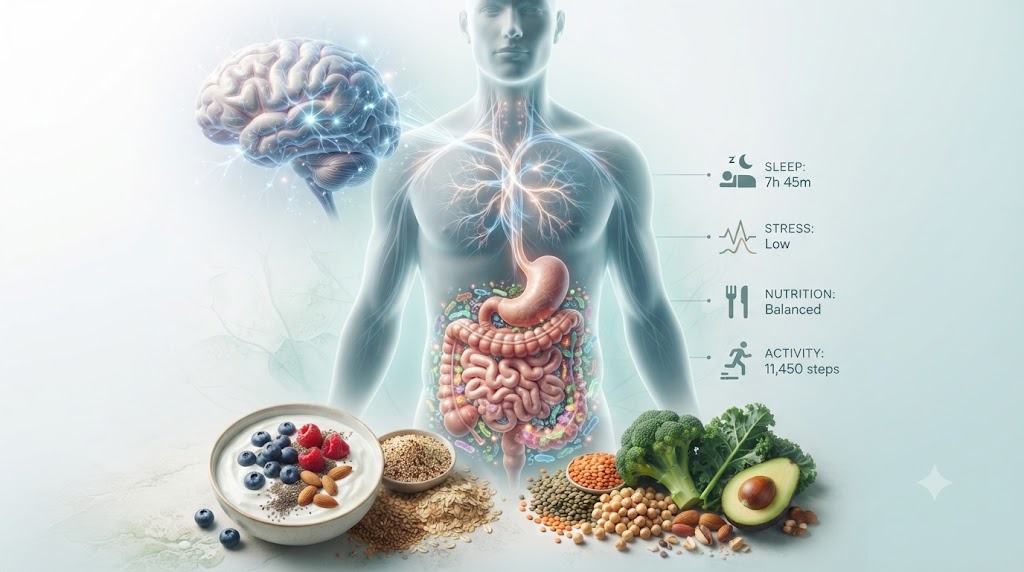
🖼️ Image suggestion: A premium medical illustration showing the human brain and digestive tract connected by glowing neural pathways, with subtle representations of gut microorganisms and immune signals.
🦠 The Gut Microbiome: A Complex Internal Ecosystem
The human gut contains a vast community of bacteria and other microorganisms.
These organisms can help break down components of food that the human digestive system cannot fully process. They can also produce metabolites and interact with the intestinal immune environment.
The composition of the microbiome differs considerably between individuals.
Diet, age, lifestyle, medications, environment, and other factors can influence the microbial community. Antibiotics, for example, can substantially alter gut bacteria.
Researchers are studying whether particular microbiome patterns are associated with digestive disorders, metabolic health, immune function, and mental health.
However, an important distinction is necessary: an association does not necessarily mean that a particular microorganism causes a specific health outcome.
This remains one of the major challenges in microbiome research.
🧠 How Stress Can Affect Digestion
Most people have experienced the connection between emotions and digestion.
Stress can influence gastrointestinal function through the nervous system and hormonal responses. Some people may experience changes in appetite, bowel movements, abdominal discomfort, or other digestive symptoms during stressful periods.
The relationship also works in the opposite direction.
Persistent digestive symptoms can be frustrating, disruptive, and stressful. This creates a feedback loop in which psychological and gastrointestinal experiences may influence each other.
This does not mean that symptoms are “just psychological.” Digestive symptoms are real physical experiences and can have many causes.
Understanding the gut-brain connection can instead encourage a more integrated view of digestive health.
🌱 Fiber: Food for Your Gut Microorganisms
Dietary fiber is one of the most important nutritional factors influencing the gut environment.
Fiber is found in foods such as vegetables, fruits, legumes, whole grains, nuts, and seeds.
Some types of fiber are fermented by gut microorganisms. This process can produce compounds called short-chain fatty acids, which have important roles in the intestinal environment and metabolism.
A diet containing a variety of fiber-rich plant foods can therefore support a diverse nutritional environment for gut microorganisms.
However, increasing fiber too quickly can cause bloating or discomfort in some people. Gradually increasing intake and drinking adequate fluids can make the transition easier for many individuals.
People with certain gastrointestinal conditions may need individualized dietary guidance.
🖼️ Image suggestion: Colorful fiber-rich foods—berries, vegetables, lentils, oats, beans, nuts and seeds—surrounding a visual representation of healthy gut microorganisms.
🥗 Diet and the Gut-Brain Connection
What we eat influences the environment in which our gut microorganisms live.
A dietary pattern rich in diverse plant foods provides different fibers and nutrients that can support microbial activity. Diets dominated by highly processed foods may provide a different microbial environment.
Researchers are studying dietary patterns rather than focusing only on individual “superfoods.”
A varied diet can provide a broader range of nutrients and fermentable substrates.
This does not mean that one specific food can “heal” the gut or dramatically change mental health overnight. Gut biology is influenced by many factors, and dietary changes generally work best as part of a broader healthy lifestyle.
🧪 The Role of Microbial Metabolites
One of the most interesting areas of gut-brain research concerns substances produced when microorganisms interact with food.
Some gut microbes produce metabolites that can interact with intestinal cells, immune pathways, and other biological systems.
Short-chain fatty acids are among the best-known examples.
Researchers are investigating whether microbial metabolites can influence brain-related processes through immune, metabolic, and neural pathways.
Scientists are also studying the relationship between gut microorganisms and molecules involved in neurotransmitter biology.
But it is important not to oversimplify this science.
Finding a biological pathway does not automatically demonstrate that changing the microbiome will improve a particular person’s mental health.
Human clinical studies are still needed to determine which interventions are effective and for whom.
😴 Sleep, the Gut, and Mental Wellness
Sleep is another part of the gut-brain relationship.
Poor sleep can influence appetite, food choices, stress levels, immune function, and metabolic processes. These changes may also affect the gut environment.
At the same time, digestive discomfort can make it more difficult to sleep comfortably.
This creates another potentially interconnected cycle.
A healthy routine that includes regular sleep, balanced nutrition, physical activity, and stress management may therefore support multiple systems simultaneously.
Rather than treating gut health and sleep as completely separate topics, an integrated approach recognizes their potential interactions.
🏃 Exercise and the Microbiome
Physical activity is associated with numerous health benefits, and researchers are investigating its relationship with the gut microbiome.
Regular exercise can influence metabolism, circulation, immune function, and gastrointestinal activity. Studies have also reported associations between physical activity and differences in gut microbial composition.
However, the exact relationship is complicated.
Diet, fitness level, body composition, age, and other lifestyle factors can also influence the microbiome. Therefore, it is difficult to attribute observed microbial differences to exercise alone.
Nevertheless, regular physical activity remains an important part of overall health regardless of its precise microbiome effects.
Walking, cycling, swimming, strength training, and other enjoyable forms of movement can contribute to a healthy lifestyle.
🧘 Stress Management and Digestive Health
Because stress can influence gastrointestinal function, stress-management strategies may be useful for some people experiencing digestive symptoms.
Practices such as mindfulness, breathing exercises, yoga, regular physical activity, relaxation techniques, and maintaining social connections can support general well-being.
The goal is not to suggest that stress is the cause of every digestive condition.
Instead, stress management can be considered one component of a broader health strategy.
For people with persistent gastrointestinal symptoms, professional medical evaluation remains important.
🧠 The Gut-Brain Connection and Mental Health Research
Scientists are increasingly investigating associations between the gut microbiome and mental-health conditions.
Research has explored relationships involving depression, anxiety, stress-related disorders, and other neurological or psychiatric conditions.
Some studies suggest that differences in gut microbial communities may be associated with these conditions.
However, the direction of the relationship remains an important scientific question.
Mental health can influence diet, sleep, physical activity, medications, stress biology, and many other factors that can also affect the gut microbiome.
Therefore, researchers are cautious about claiming that microbiome changes directly cause mental-health conditions.
Future clinical trials may help determine whether specific dietary or microbiome-targeted interventions have meaningful benefits.
💊 Probiotics and Prebiotics: What Is the Difference?
The terms probiotic and prebiotic are often used when discussing gut health.
Probiotics are live microorganisms that, when consumed in adequate amounts and under appropriate conditions, can provide a health benefit.
Prebiotics are substrates that are selectively utilized by host microorganisms and can support beneficial microbial activity.
They are not interchangeable.
Probiotic effects can also be highly specific to particular strains and health outcomes. A product that has evidence for one purpose may not have evidence for another.
This is why consumers should be cautious about broad claims that any probiotic product will automatically improve digestion, immunity, or mental well-being.
🥛 Fermented Foods and Gut Health
Fermented foods have attracted substantial interest because fermentation can introduce microorganisms and alter food components.
Examples include yogurt with live cultures, kefir, certain fermented vegetables, and other traditionally fermented foods.
Some fermented foods can be part of a balanced diet and may provide useful nutrients or live microorganisms.
However, not every fermented product contains the same microorganisms or has the same potential effects.
For people with specific dietary restrictions or health conditions, food choices should be individualized.
The broader principle is more important than any single food: a diverse, nutrient-rich diet is generally a better foundation than relying on one “miracle” ingredient.
🔬 Why Microbiome Testing Is Not Yet a Complete Health Solution
At-home microbiome testing has become increasingly popular.
These tests can provide information about microorganisms detected in a stool sample. But interpreting what those results mean for an individual’s health can be difficult.
The microbiome changes over time and varies between people.
There is also no universally agreed definition of a single “perfect” microbiome.
Consequently, consumers should be skeptical of services that claim a microbiome test can precisely diagnose complex health conditions or provide a definitive personalized diet without appropriate clinical evidence.
Research is progressing, but the science remains more complicated than many marketing messages suggest.
🧬 Personalized Gut Health in the Future
As research develops, future approaches may become more individualized.
Healthcare professionals may eventually combine information about diet, symptoms, medical history, medications, lifestyle, and selected microbiome measurements to develop more targeted recommendations.
Artificial intelligence could help researchers analyze large datasets and identify patterns that would be difficult to detect manually.
Wearables could contribute information about sleep, activity, and other physiological measurements.
The ultimate goal would be to understand the interactions among multiple systems rather than treating the gut as an isolated organ.
🔐 The Importance of Evidence and Privacy
Gut-health information can be sensitive, particularly when combined with genetic, medical, lifestyle, or mental-health information.
Consumers should therefore consider how health companies collect, store, analyze, and share their data.
Scientific evidence is equally important.
A product being marketed as “microbiome-based,” “AI-powered,” or “personalized” does not automatically mean that its health claims have been clinically established.
Look for transparent information about research, study design, limitations, and the specific health outcome being investigated.
🌍 A Holistic Approach to Gut and Mental Well-Being
The gut-brain connection highlights why health should rarely be viewed as a collection of isolated systems.
Nutrition, physical activity, sleep, stress, social relationships, medications, medical conditions, and environment can all interact.
A practical approach to supporting digestive and mental well-being may include:
🥗 Eating a varied, nutrient-rich diet
🌾 Including appropriate sources of dietary fiber
💧 Staying adequately hydrated
🏃 Maintaining regular physical activity
😴 Prioritizing consistent, sufficient sleep
🧘 Practicing healthy stress-management strategies
👨⚕️ Seeking professional care for persistent or concerning symptoms
These habits are not a replacement for medical treatment, but they can form part of a broader healthy lifestyle.
🚨 When Digestive Symptoms Need Medical Attention
Not every digestive symptom should be attributed to the gut microbiome or stress.
Persistent or severe symptoms deserve appropriate medical evaluation.
Symptoms such as unexplained weight loss, blood in the stool, persistent vomiting, severe abdominal pain, difficulty swallowing, prolonged changes in bowel habits, or other concerning changes should be discussed with a healthcare professional.
Self-diagnosing based on microbiome information or online health content can delay appropriate care.
The gut-brain connection is an important scientific concept, but it should complement—not replace—evidence-based healthcare.
🔮 What the Next Generation of Gut-Brain Research May Reveal
The future of gut-brain research could bring a deeper understanding of how microorganisms, dietary patterns, metabolism, immune responses, and the nervous system interact.
Researchers may identify more precise relationships between specific microbial functions and health outcomes.
Future treatments could potentially include targeted dietary strategies, carefully selected microbial interventions, or combinations of lifestyle and medical approaches.
But scientific progress will depend on rigorous clinical research.
The goal should not simply be to discover more bacteria or develop more supplements. The more important question is whether a specific intervention produces a meaningful improvement in people’s health and quality of life.
🌟 Conclusion: A Connected View of Health
The gut and brain are connected through an intricate network involving nerves, hormones, immune signals, metabolism, and microorganisms.
This relationship helps explain why digestion, stress, sleep, nutrition, and emotional well-being can interact in complex ways.
Research into the gut-brain axis is opening exciting possibilities, particularly in understanding how diet and lifestyle influence the microbiome and how microbial activity may interact with the rest of the body.
At the same time, many questions remain unanswered.
The most practical lesson is not to search for a single “perfect” probiotic or miracle food. Instead, focus on the fundamentals: a diverse and nutritious diet, regular movement, sufficient sleep, stress management, and appropriate medical care.
As science advances, the gut-brain connection may become an increasingly important part of personalized and preventive health—but the strongest future solutions will be those supported by careful research, realistic expectations, and a whole-person approach. 🧬🧠🌿❤️
🎨 Feature Image Prompt
Premium healthcare editorial feature image, 16:9: sophisticated visualization of the human brain and digestive system connected by elegant glowing neural pathways, subtle microscopic gut microbiome organisms surrounding the intestines, healthy foods such as vegetables, berries, whole grains, yogurt, legumes, nuts and seeds integrated naturally into the composition, small visual hints of sleep, stress, nutrition and physical activity data, realistic medical illustration blended with high-end lifestyle photography, clean white and soft blue-green healthcare aesthetic, cinematic lighting, scientifically credible, modern health magazine style, spacious composition, no text, no logos.