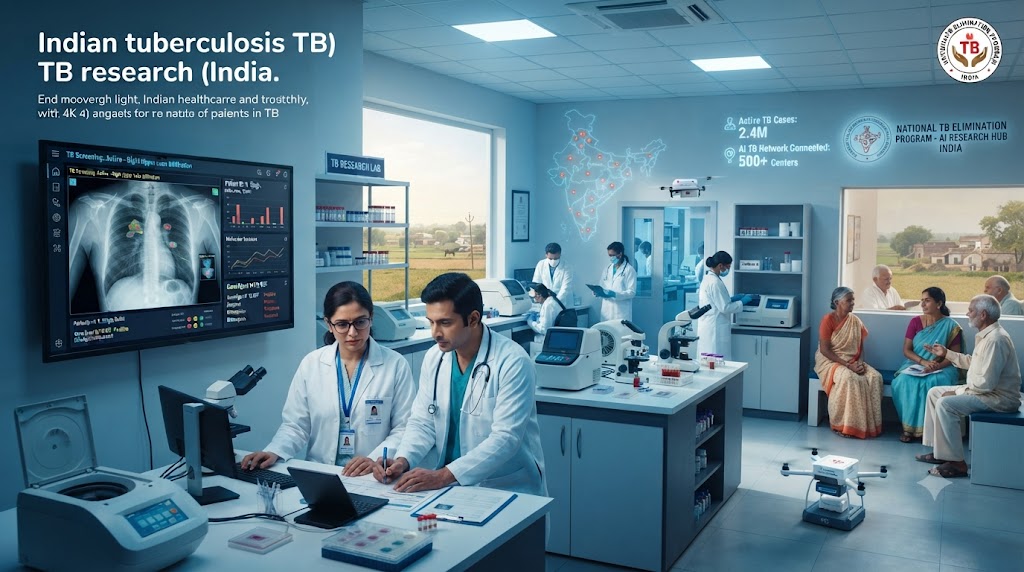
Introduction: A New Phase in India’s Fight Against Tuberculosis
Tuberculosis (TB) remains one of India’s most important infectious-disease challenges, but the country’s approach to TB research is changing rapidly. New diagnostic technologies, artificial intelligence, drone-based sample transport, genomic surveillance, shorter drug-resistant TB regimens and community-based screening are increasingly becoming part of the research and public-health landscape.
Recent Indian research is particularly focused on one central problem: how can TB be detected earlier and treatment started faster?
That question matters because delays can allow the disease to progress and can prolong opportunities for transmission. Conventional diagnostic pathways can also be difficult for people living in remote areas, where reaching a laboratory may require significant travel, time and expense.
In 2026, several developments illustrate India’s movement toward faster and more decentralized TB diagnosis. An ICMR study in Telangana found that drone-enabled transport of sputum samples reduced the median diagnostic turnaround time from 15 days to 5 days. The same study reported a substantial reduction in patient out-of-pocket expenditure.
At the same time, India is expanding AI-assisted screening, molecular testing, genomic surveillance and shorter treatment approaches for drug-resistant TB.
These developments do not represent a single new cure for tuberculosis. Instead, they show how India’s TB research strategy is increasingly combining technology, laboratory science, public-health surveillance and patient-centred care.
📊 Why Faster TB Diagnosis Matters
TB diagnosis can involve several steps, including clinical evaluation, imaging, sample collection and laboratory testing.
One of the challenges is that people with suspected TB may not always be able to produce adequate sputum samples, while diagnostic laboratories may be located far from communities.
WHO highlighted this problem in March 2026 when it issued new recommendations concerning near-point-of-care molecular tests, tongue-swab samples and sputum pooling. The recommendations were intended to make TB testing faster and more accessible, particularly where conventional laboratory infrastructure creates barriers.
For India, these developments are particularly relevant because the country has a large population spread across urban centres, rural communities, remote areas and difficult-to-reach regions.
The research priority is therefore not simply developing a test that works in a sophisticated laboratory.
The bigger question is:
Can an accurate test reach the patient quickly enough to influence treatment?
🚁 Drone Technology Could Shorten Diagnostic Delays
One of India’s most interesting recent TB innovations involves drones.
Under ICMR’s i-DRONE initiative, researchers conducted a programme-based study in Yadadri-Bhuvanagiri district of Telangana in collaboration with AIIMS Bibinagar and the district TB office.
The study enrolled 840 participants and compared conventional patient travel with a model in which sputum samples were collected at nearby primary health centres and sub-centres before being transported by drones to designated diagnostic laboratories.
The results were notable.
The median turnaround time for TB diagnosis fell from 15 days to 5 days after drone-enabled sample transportation was introduced.
The study also reported a major reduction in mean out-of-pocket expenditure, from approximately ₹9,451 under the conventional model to around ₹91 during the drone-enabled phase.
The intervention used a hub-and-spoke network connecting 11 primary health centres, 60 sub-centres and four TB units.
This approach demonstrates an important principle in healthcare innovation: sometimes faster diagnosis does not require building a laboratory in every village. Improving the movement of samples to existing diagnostic facilities can also reduce delays.
🤖 Artificial Intelligence Is Supporting TB Screening
Artificial intelligence is becoming another important component of India’s TB-control research.
The Indian government has reported the use of AI tools for community-based pulmonary TB screening, including the Cough Against TB system. According to government information released in December 2025, the system had screened more than 1.62 lakh people between March 2023 and November 2025 and had shown an additional TB case yield of approximately 12–16% in deployed settings compared with conventional screening.
AI is also being applied to chest X-ray interpretation.
Computer-aided detection systems can analyze digital chest radiographs and identify people who may require further diagnostic testing. The technology is particularly relevant where trained radiologists are limited.
However, AI screening should not be confused with definitive diagnosis.
A computer-assisted X-ray assessment can help identify people who warrant further evaluation, but confirmatory testing and clinical assessment remain important.
WHO’s TB research overview identifies computer-aided detection using digital chest radiography as one of the technologies being developed to identify people with a high likelihood of TB disease.
🩻 Portable X-Ray Technology Is Taking Diagnosis Closer to Communities
Another major research direction is the use of portable and handheld imaging systems.
Government programmes have increasingly explored AI-enabled and portable chest X-ray solutions to expand TB screening in underserved populations. In June 2026, government officials reported that states were seeking additional handheld X-ray systems and molecular diagnostic equipment to strengthen screening in difficult-to-reach populations.
The attraction is straightforward.
Instead of requiring every person with possible TB symptoms to travel to a major hospital, screening can potentially be brought closer to communities.
A portable X-ray can identify people who require additional testing, while molecular tests can then help confirm TB and detect certain forms of drug resistance.
This creates a potential diagnostic pathway:
Community screening → portable imaging → molecular confirmation → rapid treatment decision
The effectiveness of such a pathway depends on implementation quality, equipment availability, trained personnel and reliable referral systems.
🧬 Genomic Surveillance Is Becoming More Important
TB is caused by Mycobacterium tuberculosis, and different strains can have different genetic characteristics.
Genomic sequencing can help researchers understand how TB strains are related, identify drug-resistance-associated mutations and study transmission patterns.
India is increasingly emphasizing genomic surveillance as part of TB research.
At a national TB policy conclave hosted by AIIMS Bhubaneswar in August 2026, experts highlighted strengthened genomic surveillance and collaborative research as important components of the country’s TB-elimination efforts. AIIMS Bhubaneswar also announced plans to undertake advanced TB testing in two districts on a pilot basis.
Genomic surveillance can provide information that conventional surveillance cannot easily capture.
For example, researchers can investigate whether drug-resistant cases share genetic characteristics and explore possible transmission networks.
This information may eventually support more targeted interventions.
🧪 Molecular Diagnostics Are Transforming Drug-Resistance Detection
Drug-resistant TB is one of the most difficult aspects of TB control.
Traditional approaches to drug-susceptibility testing can take considerable time. Molecular diagnostic systems can detect TB and identify resistance markers much faster in appropriate settings.
India has developed and deployed molecular testing technologies such as Truenat, while other molecular platforms are also used within TB-control programmes.
WHO’s TB research pipeline includes low-complexity automated nucleic acid amplification tests, targeted next-generation sequencing and other approaches for detecting TB and drug resistance. The pipeline includes several technologies developed or being developed in India.
The objective is increasingly to move drug-resistance information closer to the beginning of the diagnostic pathway.
That matters because treatment choices depend on the resistance profile of the organism.
💊 Shorter Treatment for Drug-Resistant TB
TB treatment has historically required long treatment periods, especially for drug-resistant disease.
Recent research is changing that picture.
In February 2026, an ICMR-National Institute for Research in Tuberculosis economic evaluation examined six-month all-oral regimens for multidrug-resistant and rifampicin-resistant TB.
The study compared bedaquiline-based regimens, including BPaL and BPaLM, with shorter and longer regimens used under India’s National TB Elimination Programme. The researchers reported that BPaL was both more effective and cost-saving in their analysis, while BPaLM was highly cost-effective compared with the standard regimen.
These findings are important because shorter treatment can potentially reduce the time patients need to remain on therapy.
Shorter regimens may also reduce the logistical burden associated with long treatment courses.
But treatment decisions remain individualized. Drug resistance patterns, clinical circumstances, adverse effects and programme guidelines all influence the appropriate regimen.
💊 What Is BPaLM?
BPaLM is a four-drug regimen consisting of:
Bedaquiline + Pretomanid + Linezolid + Moxifloxacin
India has introduced this shorter regimen for eligible patients with drug-resistant TB under the national programme. Government information in March 2026 described the regimen as a shorter, safer and highly effective approach for drug-resistant TB patients.
The significance of BPaLM lies in its potential to simplify treatment compared with much longer regimens.
However, “shorter” does not mean “simple.”
Patients still require medical supervision, adherence support, monitoring for adverse effects and appropriate drug-resistance assessment.
🧬 The Future of TB Diagnostics May Not Depend Only on Sputum
One of the most interesting developments in TB research is the search for easier biological samples.
Sputum has traditionally played a central role in diagnosing pulmonary TB, but not everyone can produce a useful sputum sample.
WHO’s March 2026 recommendations included tongue swabs as an additional specimen option for certain molecular testing approaches in adults and adolescents who cannot produce sputum.
This could be especially valuable in community settings.
A diagnostic sample that is easier to collect could potentially make screening more accessible and reduce dependence on complex sample-collection procedures.
Research into non-sputum samples is therefore part of a broader shift toward patient-friendly diagnostics.
🧪 Sputum Pooling Could Improve Testing Efficiency
WHO has also recommended sputum pooling as a diagnostic strategy in specific circumstances.
The basic concept is that samples from multiple people can be pooled and tested together using appropriate molecular methods. If the pooled result is negative, individual testing may not be necessary in the same way; if it is positive, further testing can identify the individual sample responsible.
WHO says this strategy has potential to improve turnaround times and reduce testing costs when resources are constrained.
For a country as large as India, approaches that increase laboratory efficiency could have considerable practical relevance.
Implementation, however, needs to follow appropriate technical and programme guidance.
🏥 Bringing Diagnosis Closer to Primary Healthcare
A major theme in India’s TB research is decentralization.
Instead of concentrating diagnostic services in large hospitals, researchers and health programmes are exploring ways to move screening and sample collection closer to communities.
The Telangana drone study provides a good example.
Patients could provide sputum samples at nearby facilities while the samples themselves were transported to designated laboratories.
This creates a hybrid model in which:
Sample collection is decentralized.
Laboratory testing remains centralized where appropriate.
Technology connects the two.
This can potentially reduce travel requirements without requiring every small health facility to maintain a complete molecular laboratory.
🧑🤝🧑 Community Screening Is Becoming More Proactive
India’s TB strategy is also increasingly emphasizing active case finding.
The government reported in March 2026 that more than 20 crore vulnerable people had been screened for TB under the TB Mukt Bharat Abhiyaan since December 2024, with more than 28 lakh TB patients diagnosed.
The goal of proactive screening is to identify people who may have TB before they would otherwise reach the healthcare system.
This is particularly important for people who have limited access to healthcare or who may not recognize symptoms early.
AI-assisted screening, portable X-ray systems and community-based testing can work together in this model.
🧠 From Symptoms to Risk-Based Screening
Traditional healthcare often depends on people presenting with symptoms.
Newer approaches increasingly attempt to identify people at higher risk before severe disease develops.
Predictive analytics can potentially combine demographic, clinical and screening information to identify people who warrant additional assessment.
India’s government has reported the use of predictive analytics as part of its AI-driven TB programme.
However, predictive systems need careful evaluation.
A model trained using data from one population may not perform identically in another. Data quality, population representation and algorithmic bias can influence performance.
For this reason, AI should generally be considered a support tool rather than an automatic replacement for clinical judgement.
🧬 Research Is Also Looking Beyond Active TB
TB research does not end with diagnosis of active disease.
Researchers are also investigating latent TB infection, post-TB lung disease, treatment-related complications, nutrition and rehabilitation.
In June 2026, ICMR-NIRT and partners held a workshop examining research priorities involving Siddha-based approaches and TB. Topics included potential anti-mycobacterial and immunomodulatory formulations, post-TB lung disease, hepatotoxicity, nutrition and other areas. These approaches were identified for scientific evaluation; the workshop itself does not establish their clinical effectiveness.
This distinction is important.
Research proposals and research priorities are not the same as proven treatments.
Future studies will need to establish whether individual interventions provide measurable clinical benefits.
🌍 India’s TB Research Has Global Importance
India’s experience is relevant beyond its own borders.
Many countries face similar challenges involving large populations, limited specialist availability, rural communities and uneven access to diagnostic laboratories.
Technologies designed for these conditions can potentially have applications elsewhere.
Drone-enabled sample transport is one example.
AI-assisted chest X-ray screening is another.
Low-cost molecular testing and decentralized diagnostics may also be relevant to other high-TB-burden countries.
India therefore has the opportunity not only to use new TB technologies but also to contribute evidence about how those technologies can be implemented at scale.
🔬 What Researchers Still Need to Solve
Despite major progress, important challenges remain.
First, diagnostic innovations must be affordable and scalable.
A technology that works successfully in a pilot project may face very different challenges when deployed across thousands of facilities.
Second, accuracy remains essential.
False-positive results can create unnecessary testing and anxiety, while false negatives can delay treatment.
Third, drug resistance remains a moving target.
Continuous surveillance is needed to understand resistance patterns and ensure treatment regimens remain effective.
Fourth, treatment adherence and patient support remain crucial.
Even the most effective drug regimen cannot work properly if patients cannot access medicines consistently or stop treatment because of adverse effects, financial difficulties or social barriers.
Finally, data systems must be connected while protecting patient privacy.
📈 A New Model for TB Control
The direction of India’s TB research can be summarized as a move from a hospital-centred model toward a connected diagnostic ecosystem.
In the emerging model, community health workers may identify people at risk.
AI tools may help screen cough or chest X-ray images.
Portable X-ray machines may bring imaging closer to communities.
Molecular tests may rapidly confirm TB and identify drug resistance.
Drones or other logistics systems may transport samples to laboratories.
Genomic surveillance may provide additional information about resistance and transmission.
Shorter treatment regimens may reduce treatment duration for eligible drug-resistant TB patients.
Nutrition and community support may help patients remain engaged with care.
These technologies are not independent solutions. Their greatest value may come from connecting them into a functioning healthcare pathway.
🌱 What the Next Few Years Could Bring
TB research is moving toward several major goals.
The first is faster diagnosis.
The second is simpler sample collection.
The third is rapid detection of drug resistance.
The fourth is shorter and safer treatment.
The fifth is more targeted screening.
The sixth is stronger genomic surveillance.
The seventh is better integration between research and routine public-health services.
WHO’s broader TB research agenda similarly identifies rapid point-of-care diagnostics, shorter and safer treatment regimens, new vaccines and effective scale-up strategies as major priorities.
The research pipeline is therefore moving beyond the question of whether TB can be detected and treated.
The focus is increasingly on whether it can be detected earlier, treated more efficiently, and managed closer to the patient.
📝 Conclusion
India’s TB research landscape is undergoing an important transformation.
The latest developments show that faster diagnosis is being pursued through several complementary approaches: AI-assisted screening, portable imaging, molecular diagnostics, easier sample collection, decentralized testing and innovative sample transportation.
The 2026 ICMR drone study in Telangana provides a particularly clear example. Diagnostic turnaround time fell from a median of 15 days to 5 days when drone-based sputum transport was introduced, while reported patient diagnostic expenses also fell substantially.
At the treatment level, research into shorter all-oral regimens is providing evidence for more efficient approaches to drug-resistant TB. An ICMR economic evaluation published in 2026 found BPaL and BPaLM to be cost-effective compared with longer treatment approaches in its analysis.
Meanwhile, genomic surveillance, AI, community screening and advanced molecular testing are expanding the tools available to India’s TB-control programme.
The future of TB elimination will not depend on one technology alone. It will depend on how effectively India combines early detection, accurate diagnosis, appropriate treatment, patient support, surveillance and research.
For millions of people affected by tuberculosis, the most meaningful measure of scientific progress will ultimately be whether these innovations translate into earlier diagnosis, easier access to care and successful completion of effective treatment. 🫁🔬🇮🇳