Medical Innovation · Public Health · India · Diagnostic Technology
Introduction
Sickle cell disease is an inherited blood disorder that can cause severe pain, chronic anaemia, infections, organ damage and other potentially life-threatening complications. In India, early diagnosis is particularly important for tribal and underserved communities, where access to specialised diagnostic facilities and regular medical care may be limited.
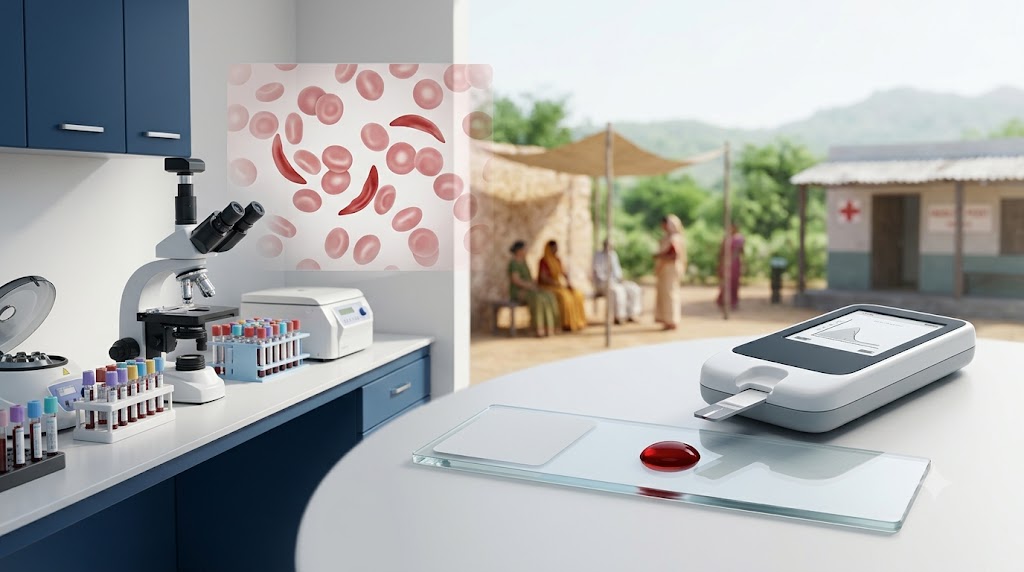
A research initiative involving researchers at the Indian Institute of Technology (IIT) Bombay has drawn attention to the potential of affordable blood-screening technology. According to the report you shared, the technology was assessed in field testing involving 394 people in tribal areas of Maharashtra and central India, with a focus on screening for sickle cell disease.
The central public-health question is straightforward: Could affordable, accessible screening help identify people with sickle cell disease earlier and connect them with appropriate care?
The answer is promising, provided the screening technology is sufficiently accurate, positive results are confirmed through appropriate diagnostic testing, and people diagnosed with the condition can access ongoing treatment and support.
What Is the New Blood-Screening Technology?

The technology developed by the IIT Bombay research team uses the physical behaviour of a small blood sample to identify changes associated with anaemia and sickle cell disease. The research was led by Professor Mahesh Tirumkudulu from the Department of Chemical Engineering. The findings were published in the scientific journal Lab on a Chip.
Instead of depending entirely on complex laboratory equipment, the approach uses controlled blood spreading, simple chemicals and measurements of the resulting blood film.
The researchers developed related methods for two different health problems:
- Anaemia screening: The length and appearance of a blood smear help estimate blood properties associated with haemoglobin levels.
- Sickle cell disease screening: Researchers compare how a blood sample spreads before and after oxygen is removed from it, looking for changes associated with abnormal haemoglobin.
These are separate testing procedures, not a single measurement that independently diagnoses both diseases. Their shared advantage is the potential to use relatively simple equipment in settings where conventional diagnostic facilities are difficult to access.
How Does the Technology Work?

Step 1: Collect a small blood sample
A trained healthcare worker collects a blood sample using an appropriate clinical procedure. The sample is placed on glass slides for controlled testing.

Step 2: Measure how the blood spreads
An automated device spreads the sample under controlled conditions. Differences in blood viscosity affect the length and thickness of the resulting smear.

Step 3: Estimate haemoglobin or assess sickling behaviour
An image-based method analyses the colour of a dried blood film to estimate haemoglobin. For sickle cell screening, a separate procedure compares smear measurements before and after chemical deoxygenation.

Step 4: Refer people who need further testing
Results can help identify people who may need confirmatory diagnostic tests, medical assessment or follow-up care.
The underlying principle is that blood does not behave identically in every person. Anaemia can change the concentration of red blood cells and haemoglobin, while sickle cell disease can cause red blood cells to become rigid under low-oxygen conditions. These changes affect how blood flows and spreads.
Importantly, this is a screening approach. It should not be treated as a universal replacement for established laboratory tests.
What Did the Field Tests Find?
The field assessment involving 394 people in tribal areas of Maharashtra and central India is an important part of the research because it examined the method outside a purely laboratory-based setting.
According to IIT Bombay’s research summary, the team observed different changes in blood viscosity after oxygen was removed from samples from healthy individuals, people carrying the sickle cell trait and people with sickle cell disease.
The reported findings are summarised below.
| Group studied | Reported increase in viscosity after deoxygenation |
|---|---|
| Healthy individuals | Less than 17% |
| People with sickle cell trait | 17%–70% |
| People with sickle cell disease | More than 70% |
These are reported research findings, not universal clinical thresholds. The researchers caution that cutoffs can vary between population groups.
The team reported approximately 95% correct classification in the field assessment. That is encouraging, but it does not mean that the technology is 100% accurate or that every person tested will receive a correct result.
Larger studies involving diverse populations and comparisons with established diagnostic methods will be important before widespread clinical adoption.
Why Is Sickle Cell Disease an Important Public-Health Concern in India?
Sickle cell disease is an inherited condition involving haemoglobin, the protein in red blood cells that transports oxygen around the body.
In people with the disease, abnormal haemoglobin can cause red blood cells to become rigid and assume a curved or sickle-like shape, particularly under low-oxygen conditions. These cells may break down prematurely or obstruct small blood vessels.
Possible complications include:
- Chronic anaemia and fatigue.
- Episodes of severe pain.
- Increased susceptibility to certain infections.
- Acute chest syndrome and other serious complications.
- Damage to organs over time.
The severity varies considerably between individuals. Early diagnosis allows healthcare professionals to provide appropriate monitoring, preventive care, counselling and treatment.
India’s tribal and geographically isolated communities are an important focus for screening because sickle cell disease is prevalent in several tribal populations, and access to specialised testing can be uneven. The National Sickle Cell Anaemia Elimination Mission, launched in July 2023, aims to eliminate the public-health burden of sickle cell disease in India by 2047.
A screening method that can be taken closer to people’s homes could support this broader public-health effort.
Can Low-Cost Screening Improve Early Detection?

Yes, affordable screening could improve early detection, particularly when people currently have to travel long distances to access diagnostic laboratories. However, the greatest benefit would come from combining affordable tests with reliable referral systems and continued medical care.
Bringing screening closer to rural communities
In remote villages, the cost of travelling to a hospital can be a significant barrier. Patients may need to pay for transportation, miss work and arrange childcare simply to undergo testing.
A portable screening device could allow trained healthcare workers to conduct initial assessments at primary health centres, community health camps and mobile medical units.
For example, a health team visiting a remote village could screen eligible residents and refer those with concerning results to an appropriate diagnostic facility. This could reduce the number of unnecessary journeys while helping people who need additional testing reach care sooner.
Identifying affected children earlier
Early identification is especially important for children with sickle cell disease. Healthcare professionals can assess their individual needs, arrange appropriate preventive measures, monitor growth and development, and educate caregivers about symptoms that require urgent medical attention.
A low-cost screening programme could help health systems identify children who might otherwise remain undiagnosed until they experience serious complications.
Nevertheless, screening must be linked to confirmatory testing and timely treatment. A test that identifies a possible case but fails to connect the patient with care cannot deliver its full potential benefit.
Improving access to screening for adults
Adults can also benefit from screening, particularly if they have never been tested or do not know their sickle cell status.
Identifying sickle cell trait is important for informed genetic counselling. People with the trait are not the same as people with sickle cell disease, and counselling should communicate this distinction clearly and respectfully.
Screening programmes must protect privacy and prevent discrimination in employment, education, insurance and community settings.
How Could Affordable Testing Help Detect Anaemia?
The IIT Bombay research is particularly interesting because the broader technology also includes methods for assessing anaemia.
Anaemia occurs when the blood has insufficient haemoglobin or an inadequate number of healthy red blood cells to meet the body’s needs. It can have many causes, including iron deficiency, vitamin deficiencies, inherited blood disorders, chronic inflammation and blood loss.
The researchers developed an image-based approach that estimates haemoglobin levels from the colour intensity of a dried blood film. Separate testing reported in news coverage included an evaluation involving more than 1,000 patients, with haemoglobin estimates approximately within ±0.5 g/dL of the comparison values. Another assessment of severe anaemia reported 95.1% sensitivity and 86% specificity.
These measurements are promising, but they describe different performance measures and study assessments. They should not be combined into one overall accuracy figure.
For clinical use, an estimated haemoglobin level must be interpreted in context. A screening result cannot determine the underlying cause of anaemia, and patients may need a complete blood count, iron studies or other investigations.
The technology could be particularly useful as an initial assessment tool in communities where access to laboratory testing is limited.
What Makes This Technology Potentially Affordable?
Conventional sickle cell testing can require specialised equipment, trained laboratory personnel and procedures for processing and analysing samples. These resources may not be readily available in smaller health facilities.
The IIT Bombay approach uses an automated blood-smearing device, glass slides, a pipette, sample-treatment chemicals and a ruler or imaging equipment for measurement. The researchers describe the apparatus as designed for cost-effective manufacture.
Several features could support its use in lower-resource settings.
Lower equipment requirements
A simpler testing setup could make initial screening possible in smaller facilities that cannot readily support sophisticated diagnostic equipment.
Potential for decentralised testing
Portable equipment could allow screening teams to travel to underserved villages rather than requiring every patient to visit a central laboratory.
Greater screening reach
If the complete testing process is inexpensive and reliable, health authorities could potentially screen more people within a fixed budget.
Potentially simpler workflows
Standardised sample preparation and straightforward measurements may reduce dependence on specialised laboratory infrastructure, although training and quality control remain essential.
One important qualification is that the total cost includes more than the device. Health systems must also account for staff training, consumables, maintenance, quality assurance, confirmatory tests, patient transport and treatment.
The technology’s actual cost per correctly diagnosed patient will need to be established through implementation studies.
What Are the Limitations and Risks?
Low-cost medical innovation can improve access, but affordability alone does not establish clinical reliability.
False-positive and false-negative results
A false-positive result occurs when a test indicates a possible disease in someone who does not have it. A false-negative result occurs when a person with the disease receives a reassuring result.
Both can have consequences. False positives may cause anxiety and unnecessary referrals, while false negatives can delay diagnosis and treatment.
The reported approximately 95% classification performance in the field assessment is encouraging, but performance must be examined across different populations and clinical circumstances. The number of participants, prevalence of disease, study design and the reference test used all affect how results should be interpreted.
Population differences
The researchers have cautioned that genetic differences between populations may influence how blood responds to oxygen removal. Consequently, screening thresholds established in one group may not perform identically in another.
This is especially important when developing screening programmes for India’s diverse communities. Independent validation in additional regions and population groups will be necessary.
Other conditions that affect results
The relationship between blood viscosity, haemoglobin and disease is not always straightforward. Certain conditions, including hyperviscosity syndrome, may affect the reliability of the anaemia assessment.
A screening device must therefore be evaluated against established diagnostic methods, and clinicians must retain the ability to investigate results that do not fit a patient’s symptoms or medical history.
Regulatory approval and clinical validation
As reported in October 2026, the researchers were working with the National Institute for Research in Tribal Health, Jabalpur, and AIIMS Nagpur towards regulatory approval. The technology had been licensed to IIT Bombay startup Rheoheme Private Limited.
This means that its potential should not be confused with confirmation that it is already approved for routine clinical use everywhere.
Before widespread deployment, regulators and health authorities will need appropriate evidence of safety, performance, manufacturing consistency and suitability for the intended use.
Could the Technology Help Monitor Treatment?
An additional research finding suggests that the technique might have applications beyond initial screening.
The team assessed blood samples from patients receiving hydroxyurea, a medicine commonly used to manage sickle cell disease. In the reported observations, the increase in viscosity after deoxygenation fell from around 125% to approximately 70% in treated patients. This suggested that the method might help investigate treatment response.
However, a change in this measurement is not, by itself, proof that a treatment is working adequately for an individual patient.
Sickle cell disease management requires clinical assessment, monitoring for complications and appropriate laboratory investigations. Treatment decisions should not be based solely on this experimental measurement.
Further research would need to determine how reliably the method tracks meaningful clinical outcomes and whether it provides useful information beyond established monitoring approaches.
How Could India Implement Affordable Screening Successfully?
Turning a promising research result into a useful public-health service requires a carefully planned system.
- Validate the technology in different regions. Conduct larger studies involving diverse age groups, genetic backgrounds and healthcare settings, comparing results with established diagnostic methods.
- Train community health workers. Provide clear procedures for collecting samples, operating equipment, interpreting screening results and referring patients.
- Connect screening with confirmatory testing. People with positive or uncertain results should have access to appropriate diagnostic tests, such as haemoglobin analysis using validated laboratory methods.
- Integrate with existing health programmes. Where appropriate, screening could complement the National Sickle Cell Anaemia Elimination Mission and established anaemia-control services rather than creating a disconnected programme.
- Ensure treatment and follow-up. Build referral pathways for counselling, preventive care, medical management and ongoing monitoring.
- Measure real-world impact. Track the number of people screened, confirmed diagnoses, time to diagnosis, costs, missed cases, successful referrals and patient outcomes.
A phased rollout would help determine whether the device performs consistently under everyday conditions. Pilot programmes could begin in selected primary health centres and mobile screening units before expansion to larger geographical areas.
Health authorities should also involve local communities when designing these programmes. Clear communication in local languages can explain what the test does, what its results mean and why additional testing may sometimes be required.
What Does This Mean for the Future of Rural Healthcare?

The research reflects a broader shift in healthcare innovation: designing diagnostic tools around the practical realities of the people who need them.
Many medical technologies are developed for well-equipped hospitals. Yet millions of people live in communities where the nearest specialist laboratory may be far away. Portable, affordable diagnostic methods could help bridge that gap.
The potential impact extends beyond sickle cell disease and anaemia. The researchers are exploring whether related approaches might eventually be adapted to assess other health indicators, including blood clotting time and glucose levels. These are future research possibilities, not established capabilities of the current screening method.
For India, the broader lesson is that medical innovation should be judged not only by technical performance but also by accessibility, affordability, reliability and its ability to improve patient outcomes.
A device that performs well in a laboratory but remains inaccessible to rural patients has limited public-health impact. Conversely, a low-cost device that is well validated, easy to deploy and connected to appropriate care could become a valuable part of a larger diagnostic system.
Conclusion
The low-cost blood-screening technology developed by IIT Bombay researchers represents a promising development in India’s efforts to make essential healthcare more accessible. Its use of blood-spreading behaviour and image analysis could offer a practical way to screen for anaemia and sickle cell disease in places where specialised diagnostic facilities are difficult to reach.
The field assessment involving 394 people and the reported approximately 95% classification performance for sickle cell screening provide encouraging early evidence. Nevertheless, further validation, regulatory review and real-world implementation research are necessary before the technology can be relied upon for widespread clinical screening.
The biggest opportunity is not simply to create a cheaper blood test, but to make early diagnosis possible for people who have historically faced barriers to healthcare. If affordable screening is paired with confirmatory diagnosis, counselling and continuing treatment, it could help India move closer to more equitable and accessible healthcare.