Health Research · Cancer Detection · Medical Technology


Lung cancer remains a major global health challenge, and one of the most difficult aspects of treatment is detecting when the disease returns after surgery or other therapy. A promising area of research is circulating tumour DNA (ctDNA) testing, a blood-based technique that may identify molecular signs of cancer recurrence before abnormalities become visible on conventional imaging scans.
Recent reporting has highlighted research in which ctDNA testing detected possible lung cancer recurrence approximately 16.7 months before conventional scans in some cases. This finding points to the potential of liquid biopsies to improve cancer monitoring, although further clinical validation is necessary before the approach can be used routinely for all patients.
How Does a Liquid Biopsy Work?

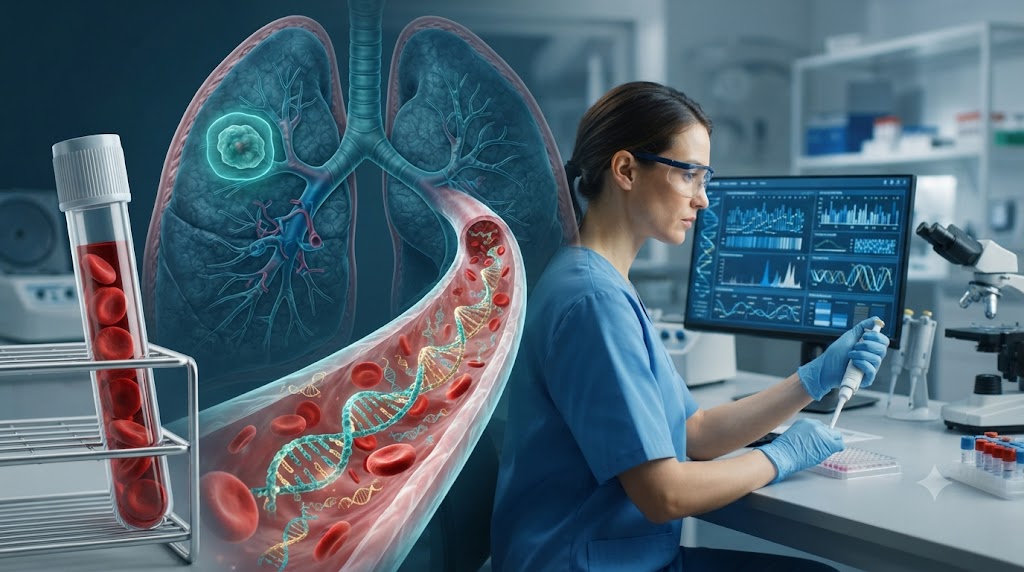
A liquid biopsy is a medical test that analyzes a sample of blood or another body fluid for biological clues associated with cancer. Unlike a conventional tissue biopsy, which requires a sample taken directly from a suspected tumor, a liquid biopsy can search for cancer-related material circulating in the body.
One of its important targets is ctDNA, which consists of small DNA fragments released by tumor cells into the bloodstream.
The process generally involves several steps.
First, a blood sample is collected. A healthcare professional takes a blood sample, which is processed to separate the plasma containing cell-free DNA.
Next, researchers analyze the DNA. Specialized sequencing technologies examine the genetic material for patterns or mutations associated with the patient’s cancer. Some tests use information from the original tumor to identify a personalized genetic signature.
Then, the results are interpreted. If cancer-associated DNA is detected after treatment, it may indicate that a small amount of cancer remains or that the disease is returning. This is sometimes called molecular residual disease or minimal residual disease (MRD).
Finally, clinicians consider the result alongside the patient’s medical history, symptoms, imaging results and other laboratory findings. A blood test alone cannot establish every aspect of a cancer diagnosis.
What Did the Latest Lung Cancer Study Discover?
According to research reported by Medical News Today on October 23, 2026, investigators evaluated a blood-based DNA analysis approach for detecting recurrence in patients with early-stage lung adenocarcinoma. The findings were published in The Journal of Molecular Diagnostics.
The study involved 42 patients with stage IA lung cancer. Researchers used tumor-informed whole-genome sequencing to identify genetic signatures associated with the cancer and then searched for those signatures in blood samples.
The reported results were encouraging:
16.7 months
Median lead time before clinical or imaging recurrence among patients with detectable ctDNA and confirmed recurrence.
75% sensitivity
The test detected ctDNA in 9 of the 12 patients who ultimately experienced recurrence.
83% specificity
The reported measure of the test’s ability to identify patients who did not experience recurrence.
Source: Study summary in The Journal of Molecular Diagnostics, reported in October 2026.
These numbers require careful interpretation. The study was small and retrospective, so its findings need confirmation in larger, prospective studies. The 16.7-month figure is a median for a particular subgroup, not a guarantee that every patient can receive a warning that far in advance.
The study also suggests that tumor-informed genetic analysis may help distinguish a returning cancer from a new, independent lung cancer in some difficult cases. That distinction matters because the two situations may require different diagnostic evaluations and treatment strategies.
Why Is Earlier Detection of Lung Cancer Recurrence Important?
Lung cancer can recur even after treatment that initially appears successful. Following surgery, some patients may have microscopic cancer cells that remain undetected by conventional imaging.
CT scans provide detailed pictures of the body’s internal structures. They are essential for monitoring lung cancer, but very small deposits of cancer may not yet form a clearly visible abnormality.
A molecular blood test could potentially identify signs of disease during this gap between the earliest biological changes and the appearance of a detectable tumor.
Identifying molecular residual disease
If ctDNA remains detectable after surgery, it may indicate that cancer-associated genetic material is still being released into the bloodstream. In the right clinical context, this can signal an increased risk of recurrence.
Doctors could potentially use this information to identify patients who need closer assessment or further investigation. However, a positive result does not automatically prove that a visible cancer has returned.
Supporting personalized follow-up care
Not every patient has the same risk of recurrence. Future research may establish whether repeated ctDNA testing can help doctors adjust the intensity of monitoring according to each patient’s risk.
For example, a persistently positive result might prompt a clinical team to review imaging schedules or consider an appropriate clinical trial. Any change to follow-up or treatment should be guided by validated evidence and specialist judgment.
Informing additional treatment decisions
Some patients with lung cancer receive additional treatment after surgery to reduce the risk of recurrence. These treatments can have side effects, so identifying who is most likely to benefit is an important research goal.
Researchers are investigating whether molecular residual disease testing can help distinguish patients who may benefit from additional therapy from those who may not.
The key question is not simply whether the test can detect cancer earlier, but whether acting on the result improves patients’ outcomes.
Liquid Biopsy vs Conventional Cancer Scans
| Feature | Liquid biopsy (ctDNA) | Conventional imaging |
|---|---|---|
| What it detects | Cancer-associated DNA fragments | Structural changes or visible abnormalities |
| Sample or procedure | Blood sample | CT, PET or other imaging |
| Potential advantage | May reveal molecular changes before a tumor becomes visible | Shows the location and extent of suspicious abnormalities |
| Important limitation | May miss cancers that release very little ctDNA | Very small tumors may be difficult to detect |
| Current role | Emerging tool for recurrence-risk assessment | Established part of lung cancer monitoring |
The two approaches are complementary rather than interchangeable. A blood test may provide an early molecular warning, while imaging helps clinicians determine whether an abnormality is present and where it is located.
Research published in 2025 also found that ctDNA detection after treatment was associated with a higher risk of recurrence in patients with early-stage non-small-cell lung cancer. However, that research emphasized the need for further evidence before ctDNA testing can reliably guide treatment decisions in routine practice.
What Are the Limitations of Liquid Biopsies?
Despite their potential, liquid biopsies have several important limitations.
False-negative results: Some tumors release very little DNA into the bloodstream. A patient may therefore have residual cancer even when a blood test does not detect ctDNA. A negative result should not be interpreted as proof that cancer is absent.
False-positive results: A positive result does not always mean that a clinically detectable recurrence is present. Results require careful interpretation and, when appropriate, additional investigation.
Small study populations: The October 2026 study included only 42 patients with stage IA lung cancer. Its performance estimates may not apply to people with other cancer stages, tumor types or treatment histories.
Uncertain treatment benefits: Detecting recurrence earlier does not necessarily mean that patients will live longer. Clinical trials must establish whether treatment initiated in response to a positive ctDNA result improves survival or quality of life.
Cost and accessibility: Advanced sequencing and specialized laboratory analysis may be expensive or unavailable in some healthcare settings. Wider adoption will depend on test standardization, affordability and clinical usefulness.
For these reasons, liquid biopsies should currently be viewed as a promising addition to cancer research and, where appropriate, specialist-led care—not a universal replacement for recommended follow-up scans.
What Could the Future of Cancer Detection Look Like?
Future liquid biopsy research may combine ctDNA with other biological indicators, including proteins, immune-system signals and additional molecular biomarkers. Combining these measurements could potentially improve the accuracy of recurrence prediction.
Artificial intelligence may also help researchers analyze complex genetic patterns and distinguish meaningful cancer signals from background biological variation. However, AI-supported analysis must be validated in independent patient populations before its results can be trusted for clinical decisions.
Another important direction is longitudinal monitoring. Instead of relying on a single blood test, clinicians may eventually be able to study changes in ctDNA levels over time. Repeated measurements could provide more information about whether molecular signs are emerging, persisting or disappearing after treatment.
For India, these advances could eventually be relevant to cancer-care research and precision medicine. However, their practical value will depend on reliable laboratory infrastructure, affordability, appropriate clinical guidelines and evidence that earlier detection leads to better outcomes.
The next major milestone will be prospective clinical trials involving larger and more diverse groups of patients. These studies need to determine which patients benefit from testing, how often blood samples should be collected and what clinicians should do when a result becomes positive.
Conclusion
Liquid biopsy technology offers a promising new approach to monitoring lung cancer after treatment. By detecting circulating tumour DNA, researchers may be able to identify molecular signs of recurrence before conventional imaging reveals a visible tumor.
The October 2026 study reported a median lead time of 16.7 months in a specific subgroup of patients with early-stage lung adenocarcinoma. Although this finding is encouraging, the study was small, and further validation is necessary.
The most important future question is whether detecting recurrence earlier can help doctors deliver more effective treatment, avoid unnecessary interventions and improve survival. If larger clinical studies demonstrate these benefits, ctDNA testing could become an important component of personalized lung cancer monitoring.
For now, the technology represents a promising step toward more sensitive, individualized cancer care.