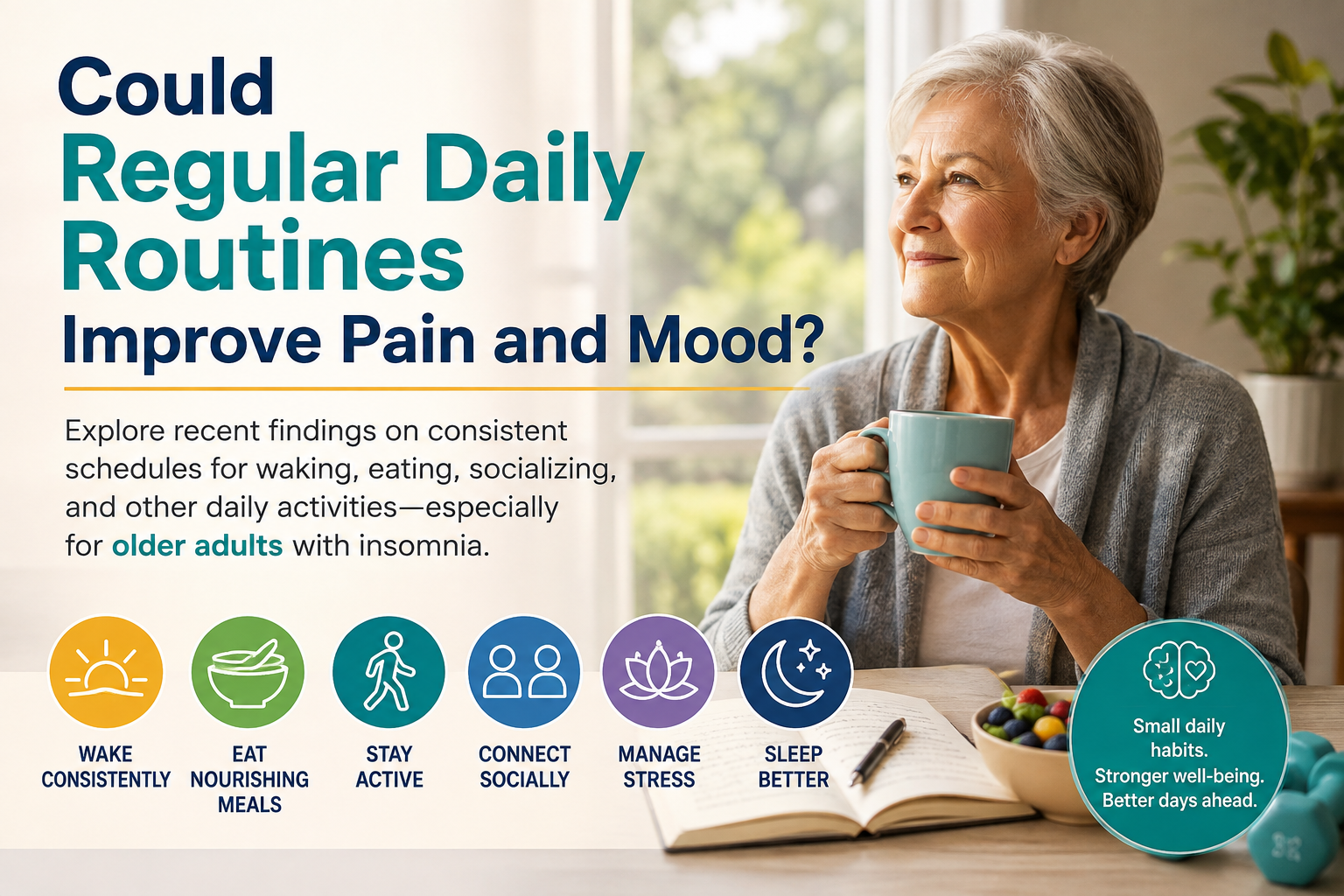


How Consistent Sleep, Meals, Movement, and Social Connection May Support Healthy Aging
What if some of the simplest things we do every day—getting up at a similar time, eating meals on schedule, taking a walk, talking with friends, and preparing for bed consistently—could influence how we feel physically and emotionally?
This question is attracting growing attention from researchers studying sleep, healthy aging, chronic pain, depression, circadian rhythms, and daily behavior.
For older adults, the connection may be especially important. Aging can bring changes in sleep patterns, retirement, reduced physical activity, changes in social relationships, chronic health conditions, and greater vulnerability to pain. At the same time, insomnia and depressive symptoms can make maintaining a structured day more difficult.
Recent research is beginning to suggest that the regularity of daily activities may matter alongside the activities themselves.
A 2026 study involving older adults examined what researchers call behavioral-social rhythms—the regular patterns of everyday activities such as sleeping, eating, moving, and interacting socially. The researchers found that greater regularity was associated with lower pain and fewer depressive symptoms. Participants experiencing insomnia generally reported more difficulties, but consistent daily patterns were still associated with better outcomes.
These findings are intriguing, but they do not prove that routines directly cure pain, insomnia, or depression. The study was relatively small and observational, meaning that researchers identified relationships rather than establishing cause and effect.
Still, the research raises an important question:
Could a more predictable daily routine become one small piece of a healthier aging strategy?
The answer may be yes—but probably not because a routine is magical. Instead, regularity may help coordinate several systems that influence one another, including sleep, mood, activity, social connection, and the body’s internal biological clock.
Let’s explore what researchers currently understand and how older adults might translate these findings into practical everyday habits. 🧠❤️
🌞 What Are Daily Behavioral Rhythms?
Our lives naturally contain rhythms.
We wake up.
We eat.
We move.
We work or perform household activities.
We interact with other people.
We relax.
We sleep.
Then the cycle begins again.
The human body is designed to respond to recurring patterns of light, activity, food, sleep, and social interaction. One of the most important timing systems is the circadian rhythm, an approximately 24-hour biological cycle that influences sleep and wakefulness and interacts with many physiological processes.
The circadian system receives powerful signals from the environment. Light is one of the most important. But daily behavior also provides information about what time of day it is.
For example, morning daylight tells the body that the active portion of the day has begun. Physical activity reinforces daytime behavior. Regular meals can provide additional timing signals. Social interactions can also contribute to the rhythm of everyday life.
This is why researchers increasingly distinguish between simply doing healthy things and doing them in a relatively consistent pattern.
Imagine two people.
Person A wakes at 6:30 a.m. most days, eats breakfast around 7:30, walks in the morning, has lunch around noon, socializes during the afternoon, eats dinner around 7, and begins winding down before bed.
Person B wakes at 6 a.m. one day, 10 a.m. the next, skips breakfast, eats lunch at 3 p.m., spends most of one day sitting indoors, goes to bed at midnight, and then sleeps until late morning.
Both people might theoretically eat healthy food and exercise.
But their behavioral rhythms are very different.
Researchers are interested in whether the first pattern provides the body with more predictable signals.
And for older adults, this may be particularly relevant.
🛌 Why Insomnia Matters as We Age
Sleep often changes with age.
Older adults may experience lighter sleep, more nighttime awakenings, earlier morning waking, changes in sleep timing, or difficulty maintaining a consistent sleep schedule.
Insomnia can make these problems more significant.
A person with insomnia may spend a long time trying to fall asleep, wake repeatedly during the night, or wake too early and struggle to return to sleep.
Poor sleep can affect much more than energy.
It can influence:
- 🧠 Concentration and memory
- 😔 Mood
- 💪 Physical functioning
- ❤️ Cardiovascular health
- 🚶 Daily activity
- 🩹 Pain sensitivity
- 👥 Social participation
- ⚡ Daytime energy
Pain and insomnia can also reinforce each other.
Someone with arthritis, back pain, neuropathy, or another chronic condition may find it difficult to sleep comfortably. After a poor night of sleep, the following day may bring greater fatigue and increased sensitivity to discomfort.
That can lead to less physical activity.
Less movement may contribute to stiffness or reduced physical fitness.
The person may then become even more uncomfortable at night.
And the cycle continues.
This is one reason researchers are interested in interventions that can influence several parts of the sleep-pain relationship at the same time.
A consistent daily schedule could potentially provide one such behavioral foundation.
🔄 The Pain-Sleep Connection
Pain is not simply a signal from damaged tissue.
The way the nervous system processes pain can be influenced by sleep, stress, mood, physical activity, and other factors.
When someone is sleep deprived, the nervous system may become more sensitive to unpleasant sensations.
This does not mean that poor sleep creates every type of pain. Conditions such as arthritis, injuries, inflammatory disorders, nerve damage, and other medical problems can have clear physical causes.
But sleep can influence how strongly pain is experienced.
Research involving older adults has found relationships between sleep and next-day pain. Better sleep can be followed by lower pain in some individuals, while disrupted sleep may be associated with increased discomfort.
This creates an important possibility:
Improving sleep could be one component of a broader approach to pain management.
And improving sleep does not necessarily begin at bedtime.
It can begin in the morning.
A stable wake time, exposure to daylight, daytime movement, appropriate activity, and predictable meal and social schedules may help create stronger distinctions between day and night.
That can make the evening transition into sleep more predictable.
🧠 Could Routine Also Influence Mood?
Mood is another important part of the equation.
Depression and low mood can disrupt everyday structure.
When someone feels depressed, activities that once seemed easy can become difficult. Getting dressed, preparing food, exercising, answering a phone call, or leaving the house may require considerable effort.
The result can be a less structured day.
A less structured day may reduce physical activity and social contact.
Reduced activity and isolation can then worsen mood.
This creates another cycle.
A routine may help interrupt that cycle by reducing the number of daily decisions a person has to make.
Instead of asking:
“Should I go for a walk today?”
the routine becomes:
“After breakfast, I walk for 15 minutes.”
Instead of:
“Should I call someone?”
the routine becomes:
“Wednesday afternoon is my family phone-call time.”
Instead of:
“When should I start getting ready for bed?”
the routine becomes:
“At 9:30, I begin my wind-down routine.”
This is not a replacement for psychological treatment when depression is significant.
However, predictable behavior can provide structure around treatment and everyday life.
For some people, routine can transform healthy behaviors from occasional intentions into regular habits.
👥 Social Connection Is Part of the Routine
One of the most overlooked parts of a healthy daily rhythm is social interaction.
A routine is not necessarily about sleep and meals alone.
Human beings are social creatures.
Regular interaction with family, friends, neighbors, community groups, clubs, or other social networks can provide emotional support and a sense of purpose.
For older adults, retirement, relocation, mobility limitations, or the loss of friends and family members can reduce social opportunities.
This can create loneliness.
Loneliness itself may be associated with poorer psychological well-being and can contribute to an increasingly inactive lifestyle.
A simple recurring social activity can therefore serve multiple purposes.
For example:
☕ Tuesday morning coffee with a friend
🚶 Daily walk with a neighbor
📞 Evening phone call with family
🎨 Weekly art class
📚 Community reading group
🌳 Morning visit to a local park
These activities provide social connection while also establishing predictable points in the day or week.
That is one reason the term behavioral-social rhythms is so interesting.
Social activity is not separate from biological timing.
It can become part of the structure that organizes everyday life.


🍽️ Why Meal Timing Could Matter
Food is usually discussed in terms of what we eat.
Protein.
Fiber.
Vegetables.
Whole grains.
Healthy fats.
Fruits.
But researchers are also studying when we eat.
Meal timing interacts with metabolic processes and may provide another behavioral cue to the body’s internal clock.
A person who eats meals at broadly predictable times may have a more stable daily pattern than someone whose meals constantly shift.
That does not mean everyone needs to eat at exactly 8:00 a.m., 1:00 p.m., and 7:00 p.m.
Human schedules differ.
The more practical idea is to avoid unnecessary chaos.
For example, eating breakfast at roughly the same time, having lunch within a regular window, and avoiding extremely late meals every night may help create greater structure.
Older adults also need to consider nutritional requirements, appetite changes, medications, diabetes, digestive disorders, and other health conditions.
Therefore, meal timing should be individualized, particularly for people taking medications that require food or those managing conditions affected by eating patterns.
🚶 Movement Can Become a Daily Anchor
Physical activity is another powerful component of routine.
Exercise has benefits for cardiovascular health, muscle strength, balance, mobility, metabolic health, and mental well-being.
But exercise does not have to mean going to a gym.
For an older adult, daily movement might include:
- Walking around the neighborhood
- Gardening 🌱
- Household chores
- Gentle stretching
- Strength exercises
- Balance exercises
- Swimming
- Dancing 💃
- Cycling
- Chair-based exercises
The most effective activity is often the activity a person can perform safely and consistently.
A daily walk can be especially useful because it combines movement with outdoor exposure.
If performed in the morning, it may also provide natural daylight.
If performed with another person, it can provide social interaction.
One simple habit can therefore influence several aspects of daily rhythm at once.
Of course, exercise should be adapted to individual ability. People with significant mobility limitations, severe pain, recent surgery, or medical conditions should ask a healthcare professional about appropriate activity.
🌙 Creating a Consistent Evening Routine
A healthy daily rhythm needs a transition into nighttime.
The goal is not to force yourself to sleep.
Instead, the objective is to gradually shift from daytime activity toward relaxation.
A simple evening routine might include:
🍽️ Eating dinner at a reasonably consistent time
📺 Reducing stimulating activities later in the evening
💡 Lowering exposure to bright light
📖 Reading a book
🧘 Practicing relaxation or gentle breathing
🛁 Taking a warm bath or shower
📝 Preparing for tomorrow
🛏️ Going to bed at a reasonably consistent time
The specific activities matter less than their predictability and personal suitability.
For someone with insomnia, however, persistent difficulty sleeping may require more than a routine.
Evidence-based treatments such as cognitive behavioral therapy for insomnia (CBT-I) can be important, and healthcare professionals can help determine whether medication, sleep disorders, pain, depression, or another medical issue is contributing.
Routine should be viewed as supportive—not as a universal cure.
⏰ How Regular Does a Routine Need to Be?
This is an important question.
Healthy routines do not require perfection.
Life is unpredictable.
A medical appointment may change your schedule.
A family celebration may push bedtime later.
Travel may disrupt sleep.
A bad pain day may reduce activity.
Trying to maintain an exact schedule every minute could create unnecessary anxiety.
Instead, think in terms of consistent anchors.
For example:
Morning Anchor 🌞
Wake up around the same time.
Daylight Anchor 🌤️
Spend some time outside or in bright daytime light.
Activity Anchor 🚶
Move your body at approximately the same part of the day.
Meal Anchor 🍎
Keep meals within broadly predictable windows.
Social Anchor 👥
Maintain regular contact with people.
Evening Anchor 🌙
Begin winding down at a similar time.
Sleep Anchor 🛌
Maintain a relatively consistent bedtime and wake time.
These anchors create structure while allowing flexibility.
📊 What Recent Research Actually Shows
The 2026 research on behavioral-social rhythms and older adults provides an important piece of evidence.
Researchers studied older adults, including individuals with insomnia, and examined relationships between regular daily behavioral patterns and health-related outcomes.
Greater behavioral-social rhythm regularity was associated with lower pain and fewer depressive symptoms.
Participants with insomnia tended to experience greater problems overall.
But researchers did not establish that changing someone’s routine would necessarily reduce their pain or depression.
This distinction is essential.
Association is not causation.
Suppose people with regular schedules report better health.
Several explanations are possible.
Maybe regular schedules improve health.
Maybe healthier people are more capable of maintaining regular schedules.
Maybe both factors influence each other.
Or perhaps another factor—such as physical activity, socioeconomic conditions, social support, or overall health—is influencing both.
That is why researchers need larger and longer intervention studies.
Future studies could randomly assign people to structured-routine programs and compare their outcomes with people receiving usual care.
Such research would provide stronger evidence about whether deliberately improving behavioral regularity can improve pain, mood, sleep, or quality of life.
🧬 The Future of Personalized Daily Routines
Technology could make this area of research even more interesting.
Wearable devices can already measure information such as:
⌚ Activity
😴 Sleep
❤️ Heart rate
🚶 Steps
🌙 Sleep timing
📱 Daily behavior patterns
Future systems may combine this information with food timing, environmental light exposure, mood reports, and other health information.
Artificial intelligence could potentially identify patterns that humans do not easily recognize.
For example, a digital health system might discover that a person’s sleep becomes less stable whenever they skip their morning walk or eat unusually late.
Another person might discover that social isolation is associated with poorer sleep.
Someone else might find that their pain is worse after nights when their bedtime changes substantially.
This could contribute to a future model of personalized behavioral medicine.
Instead of giving everyone the same advice, healthcare professionals could potentially identify which daily patterns are most strongly associated with an individual’s symptoms.
However, privacy and data security will be extremely important as wearable devices collect increasingly detailed behavioral information.
📝 Try a Two-Week Routine Experiment
If you want to explore whether regularity makes a difference in your own life, consider a simple two-week experiment.
You do not need expensive technology.
Use a notebook or phone.
Every day, record:
Wake time: ⏰
Bedtime: 🛏️
Sleep quality: 😴
Pain level: 🩹
Mood: 😊 / 😐 / 😔
Physical activity: 🚶
Outdoor time: 🌞
Social interaction: 👥
Meal timing: 🍽️
At the end of two weeks, look for patterns.
Did pain seem worse after poor sleep?
Did mood improve on days when you went outside?
Did you sleep better when your wake time was stable?
Did social contact correspond with better mood?
Did large changes in bedtime affect the following day?
The purpose is not to diagnose yourself.
It is simply to become more aware of the relationship between behavior and well-being.
If symptoms are severe or persistent, share your observations with a healthcare professional.
⚠️ When a Routine Is Not Enough
Daily structure can be helpful, but it should never delay appropriate medical care.
Talk with a healthcare professional if you experience:
- Persistent or worsening pain
- Severe insomnia
- Depression lasting for weeks
- Loss of interest in normal activities
- Major changes in appetite or weight
- Frequent falls
- Significant daytime sleepiness
- Breathing problems during sleep
- Confusion or major cognitive changes
- Pain that interferes with daily functioning
Older adults can have multiple health conditions simultaneously, and sleep difficulties can sometimes be caused by medications, sleep apnea, restless legs syndrome, depression, anxiety, pain, or other medical conditions.
A routine may support treatment, but it cannot replace diagnosis and professional care.
🌱 The Bigger Lesson: Small Habits Add Up
Modern health research often focuses on sophisticated treatments.
New medicines.
Advanced imaging.
Artificial intelligence.
Genetics.
Wearable technology.
Precision medicine.
But alongside these innovations, researchers continue to discover that ordinary behaviors remain remarkably important.
A consistent bedtime is not a high-tech intervention.
A morning walk is not complicated.
Eating meals at regular times is not revolutionary.
Calling a friend is simple.
Getting daylight during the day costs nothing.
Yet these behaviors may interact with biological systems that influence sleep, mood, physical function, and quality of life.
The emerging research on behavioral-social rhythms adds another layer to our understanding of healthy aging.
It suggests that the pattern of our day may matter almost as much as individual behaviors within it.
❤️ Final Thoughts
Could regular daily routines improve pain and mood?
The emerging evidence suggests that they may help, particularly as part of a broader healthy-aging strategy.
Recent research involving older adults found that greater regularity in behavioral and social rhythms was associated with lower pain and fewer depressive symptoms. Earlier research has also connected stable routines and sleep regularity with better sleep-related outcomes.
But the science is still developing.
A routine should not be viewed as a treatment that can cure chronic pain, insomnia, or depression. Rather, it can provide a supportive framework around proven medical and behavioral interventions.
The most useful routine is not necessarily the most complicated one.
It may simply be:
🌞 Wake at a consistent time.
🚶 Move during the day.
🍽️ Eat regular, nutritious meals.
👥 Stay socially connected.
🌳 Get daylight and outdoor exposure.
🧘 Make time for relaxation.
🌙 Create a predictable evening wind-down.
🛌 Maintain a reasonably consistent sleep schedule.
And perhaps most importantly, be consistent without demanding perfection.
Healthy aging is not about making every day identical. It is about creating enough predictable structure that the body and mind have reliable signals while still leaving room for real life.
The future of healthy aging may involve sophisticated medicines and personalized technology—but it may also recognize something remarkably simple:
A healthier tomorrow can sometimes begin by giving today a little more structure. 🌿🕰️❤️